

Construction SEO Services in USA: What Actually Moves the Needle in 2026

Construction is one of the few industries where search still reliably produces high-value work, and one of the few where most of the money spent on it is wasted. The reason is that generic search programs are built for e-commerce and adapted badly to an industry with long buying cycles, small buying committees and geographically bounded demand. This is a plain assessment of what construction SEO services in USA should include in 2026, what changed when AI answers arrived, and how to tell a genuine program from a monthly report with a nice cover. 

Why construction search is different

Four characteristics change the entire approach. 

px 245

Buying cycles run months, sometimes years

Someone researching a project in March may not select a contractor until October. Attribution built on last-click will misread almost everything. 

px 246

The buying committee is small and senior.

An owner, a developer, a CFO, a facilities director. You are not optimizing for volume, you are optimizing for the fifteen people in a metro who matter. 

px 247

Demand is geographically bounded for most work

National rankings are irrelevant if you only build in three states. 

Trust is the bottleneck rather than awareness

Nobody awards a commercial contract to a company they found ten minutes ago, so content has to carry proof rather than persuasion. 
Any program that ignores those four is optimizing the wrong things. High rankings on broad informational terms feel like progress and produce nothing.

What construction SEO services should actually include

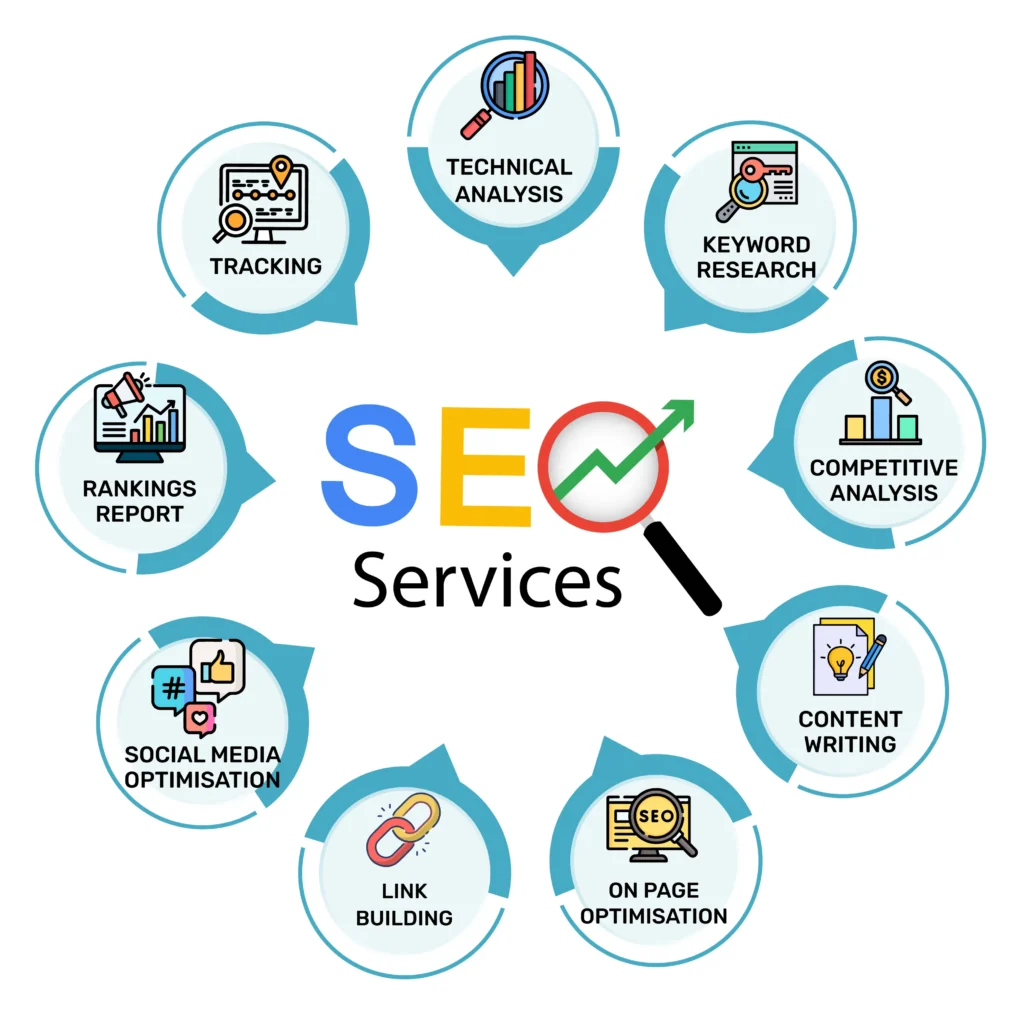
Five components, in the order they should be worked on.

Technical foundation

Crawlability, indexation, page speed on mobile, clean URL structure, correct canonicals, working XML sitemaps and structured data. Unglamorous, and it gates everything else. 
A surprising share of contractor websites have a technical problem sitting quietly underneath the content: a sitemap returning errors, service pages that are not indexed, or a redirect chain from an old domain. Our construction web development work usually starts by finding these, because paying for content on a site Google struggles to crawl is money spent twice.

Service pages built to convert, not just rank

One page per service, per market where the geography genuinely differs. Each page needs a clear description of the work, the trades or sectors served, evidence, and a specific next step. 
The most common failure is a single page covering eight services. It ranks for none of them, because it is not specifically about any of them.

Local SEO

For most contractors, this beats everything else on the list: a complete Google Business Profile, matching name/address/phone info everywhere, real reviews, and location pages that actually say something instead of just swapping in a city name. 

Content that answers real buyer questions

Not blog posts about industry trends. Content that answers what a project owner, CFO or facilities director actually types when they have a problem you solve. Narrow, specific, named. We covered the mechanics in our piece on the SEO system for predictable pipeline growth, and the pattern that works is consistently the unglamorous one: task-specific and precisely titled rather than broad and thought-leadership shaped. 
This is where content marketing for construction companies does the heavy lifting, and it compounds. A page answering a specific buyer question keeps earning for years, whereas a trends post is stale in eight months. 

Authority building

Links and mentions from places your buyers already trust: industry associations, trade publications, partner directories, local business media. In construction this matters disproportionately, because the competitive set is small and domain authority is often the deciding factor between two similar pages. 
It is also where the most damage gets done. Cheap link packages that promise fast authority are the fastest way to make a site worse, and recovering from them takes longer than earning links properly would have. 

What changed with AI search 

This is the genuine shift since 2024, and most construction SEO services in USA have not adjusted for it. Google’s AI Overviews and AI Mode now answer a large share of informational queries directly on the results page. If someone asks a general question, they frequently get an answer without a click. That has two consequences. 

px 245

Broad informational content has become materially less valuable

Ranking first on a question that gets answered in the AI summary produces impressions and very few visits. 

px 246

Being the source the AI answer draws from is now its own objective

That means clear direct answers near the top of a page, question-formatted headings, FAQ schema, tables and specific figures, and content structured so a machine can extract a clean answer. 

The practical implication is a shift in what content is worth writing. Commercial and comparison queries, where someone is choosing a provider, still convert and still get clicked. Purely informational content now needs to justify itself differently, as an authority and citation play rather than a traffic play. Any provider quoting you on impressions growth in 2026 is measuring the metric that inflated while clicks fell.

How to tell a real program from an expensive retainer

Six questions worth asking before signing anything.

Ask this 
A good answer sounds like 
A bad answer sounds like 

What will you fix in the first 60 days? 

Named technical issues and specific pages 

A content calendar 

Which keywords will you target? 

Commercial terms tied to services and markets you actually serve 

High-volume industry terms with no buying intent 

How will you build authority? 

Associations, trade press, partner directories, named outreach targets 

Guaranteed volumes of links per month 

What will you report? 

Rankings on target commercial terms, qualified inquiries, branded search volume 

Impressions and total traffic 

How do you handle AI Overviews? 

A specific approach to direct answers and structured data 

Nothing, or a vague mention of AI 

Who writes the content? 

Named people who ask you technical questions 

An unspecified team 

The single most revealing question is the fourth. A provider reporting impressions and total traffic has chosen metrics that rise regardless of whether the work produced anything.

Realistic Timelines 

Construction SEO services in USA are a compounding investment, not a campaign, and honest timelines look like this. 

Months 1 to 2

Technical fixes, Google Business Profile, service page rebuilds. Local visibility often improves first.

Months 3 to 5

Content publishing at pace, early ranking movement on lower-competition commercial terms.

Months 6 to 9

Meaningful movement on primary commercial terms, provided authority work is happening in parallel. 

Months 9 to 18

Competitive head terms. Anyone promising these in three months is either buying links or targeting terms nobody searches. 

If you need work in the pipeline inside ninety days, search is the wrong lever and paid channels are the right one. Running both is normal, and the mistake is expecting one to behave like the other. 

How this fits with everything else

Search does not work in isolation. The pages need to convert once someone lands, which is a construction web development question. Inbound inquiries need handling, which is where construction lead generation comes in. And credibility built elsewhere feeds search performance, because branded search volume rises when people encounter your name in other places. We wrote about why contractors need a specialized construction marketing agency and the argument holds for search specifically: a generalist agency will optimize a contractor the way it optimizes a dentist, and the buying cycle, committee and geography are all different. If you want a view on what is currently holding your site back, the fastest route is a technical and content audit against the commercial terms in your markets. talk to our team, or read more about how our construction SEO agency approaches it. Our customer success stories show the shape of the work.

Frequently Asked Questions

Leave a Comment

Your email address will not be published. Required fields are marked *

Scroll to Top