


The Construction CFO’s Guide to Faster Bonding Capacity Reporting
Surety companies and lenders don’t wait for your accounting team to finish assembling reports. The contractors who respond fastest with the cleanest data earn the most favorable terms.
Why Construction Bonding Capacity Reporting Is a Competitive Advantage
For most construction companies, bonding capacity dictates the size and number of projects they can pursue. Success in securing work depends on the financial information presented to the surety. However, assembling the required reporting package remains one of the most labor-intensive tasks for accounting teams. According to the Surety & Fidelity Association of America (SFAA), surety bonds underwritten for construction exceeded $8 billion in direct written premiums in 2023. The bonding market is large, competitive, and more data-driven. Contractors who deliver accurate and consistent bonding capacity reports quickly gain a measurable advantage. Sureties appreciate transparency and responsiveness. Delivering a complete bonding package within 48 hours, instead of two weeks, increases the surety’s confidence in your organization. This confidence leads to higher bonding limits and more favorable terms.

What Surety Companies Actually Evaluate in Your Financials
Understanding what bonding companies evaluate clarifies the requirements for your reporting infrastructure. Their assessment focuses not only on financial strength but also on financial visibility and discipline.
Working capital and liquidity
Sureties calculate adjusted working capital (current assets minus current liabilities) and typically extend bonding capacity at 10 to 20 times that figure. A clean, current balance sheet with clear classification of current vs. non-current items is foundational.

Work-in-progress (WIP) schedule
This is arguably the most scrutinized document in the bonding package. Sureties want earned revenue, costs to date, estimated costs to complete, projected profit or loss, and over/underbilling status for every active project.

Backlog report
The schedule of contracts awarded but not yet completed tells the surety about future revenue and resource commitment. A clear backlog report broken down by contract value, estimated start and completion dates, and remaining value demonstrates pipeline health.

Cash flow trends and bank relationships
Sureties look at how cash moves through the business. A contractor with strong working capital on paper but chronic cash shortfalls raises concern. Reporting that shows cash flow movements over time tells a more complete story than a single balance sheet snapshot.
Where the Current Bonding Reporting Process Breaks Down
In many construction companies, the bonding package is assembled manually from multiple sources. The WIP schedule is maintained in a spreadsheet by the controller. The backlog report is extracted from the ERP and reformatted in Excel. Financial statements are generated from the general ledger but often require manual modifications. Cash flow data is compiled from bank statements and accounts payable aging reports. Each step introduces delays and risks. The spreadsheet-based WIP schedule may rely on outdated percent-complete estimates. The backlog report might not include recently awarded contracts. Financial statements may omit late-posted entries. The entire process frequently depends on a few individuals with specialized knowledge. A 2024 ENR survey of top contractors found that 61% still rely on spreadsheet-based processes for some aspect of surety reporting. When a surety requests an updated package on short notice, especially during large project pursuits, the bookkeeping team must respond quickly. This urgency often conflicts with the time needed to secure accuracy.

Automating Your Construction Bonding Capacity Reporting with Power BI
The solution is not to change the surety’s requirements, but to improve how data moves from the ERP to the final reporting package. Power BI dashboards connected to your ERP platform (Sage 300 CRE, Foundation, CMiC, Procore, Jonas, or Acumatica) can automate much of the assembly process, greatly reducing accounting staff time. Automating construction bonding capacity reporting is based on a simple principle: the required data already exists in your ERP. The primary bottleneck is manual extraction and reformatting. Removing this bottleneck ensures accurate data reaches the surety more quickly, with less effort and fewer errors.
Building a WIP Dashboard with Live ERP Data for Surety Reviews
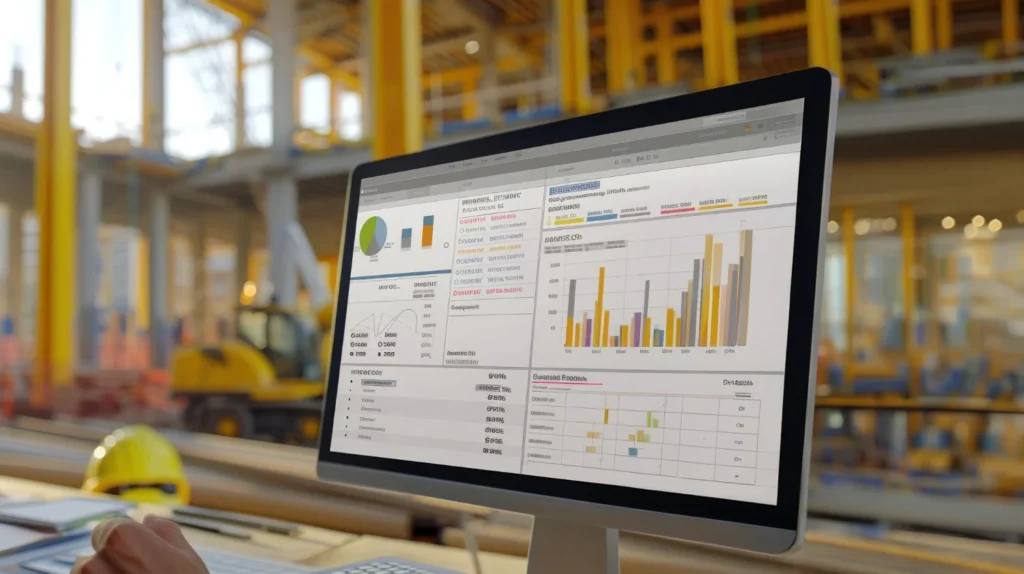
A Power BI dashboard connected directly to your ERP database can calculate earned revenue, cost to complete, and billing status using existing ERP data. When percent-complete estimates are updated, the WIP schedule recalculates automatically. The controller reviews and approves the results rather than rebuilding the report. Key WIP dashboard elements for construction bonding capacity reporting include:
Contract value, change orders to date, and revised contract total for each active project
Costs to date vs. estimated costs at completion, with projected over/under status
Revenue earned vs. billed, with underbilling and overbilling flags
Profit fade indicators showing projects where margins have declined over the past 3 reporting periods
For organizations with complex data systems that require custom integrations, the dashboard can aggregate data from multiple source systems to create the consolidated view required by the surety.
Automated Backlog and Financial Summary Reporting
Backlog calculations can be derived from contract values and costs to date in the job cost module. A Power BI report with daily refreshes ensures the backlog report consistently reflects current contract status, including recently awarded and completed projects. Essential financial metrics (working capital, current ratio, debt-to-equity, income trends) can be displayed in dashboards that update as general ledger data refreshes. While formal financial statements still require CPA involvement, the underlying data can be monitored continuously. The primary benefit of automated bonding reporting is not only speed but also consistency. Every package holds the same format, regardless of timing or preparer. Power BI reports can be exported to PDF or Excel and shared directly with the surety or CPA. For organizations where system performance impacts report generation times, optimizing the ERP environment guarantees that even complex WIP calculations refresh quickly.
The Business Impact of Faster Construction CFO Bonding Workflows
Contractors who automate bonding reporting typically reduce the time to produce a complete surety package from one to two weeks to just one to two days. This increased speed delivers significant business value.
Responding to bonding requests in time to pursue time-sensitive bid opportunities
Presenting numbers that are current rather than a month old
Freeing the controller to focus on analysis instead of data assembly
Building surety confidence via consistent, professional reporting that arrives on time, every time
For construction organizations using ERP platforms such as Sage 300 CRE, Foundation, CMiC, Procore, Jonas, or Acumatica, the necessary data for bonding reporting is already captured. The key opportunity is to connect this data to a reporting layer that generates surety-ready output on demand.
From Compliance Chore toward Strategic Capability
Contractors who view construction bonding capacity reporting as a strategic capability, rather than a compliance task, are more likely to pursue larger projects, gain more favorable terms, and attain sustainable growth. The technology is available, and the data resides in your ERP. The key question is whether your reporting process matches your organization’s ambitions. Companies that address this gap not only produce better reports but also earn the surety’s trust and greater bidding opportunities. Contact Proxsoft Technologies to learn how we develop Power BI bonding capacity dashboards for contractors using ERP platforms such as Sage 300 CRE, Foundation, CMiC, Procore, Jonas, or Acumatica. We will help you convert your existing ERP data into surety-ready reporting available on demand, eliminating unwarranted delays.